
What This Habit Helps You Do
This habit helps you move out of stuck mode.
When you keep telling yourself “I can’t do that”, your brain stops looking for options. This task teaches you to pause, notice that moment and gently switch the question.
- Not to pressure yourself.
- Not to force motivation.
- Just to explore what might make things possible.
Why It Works
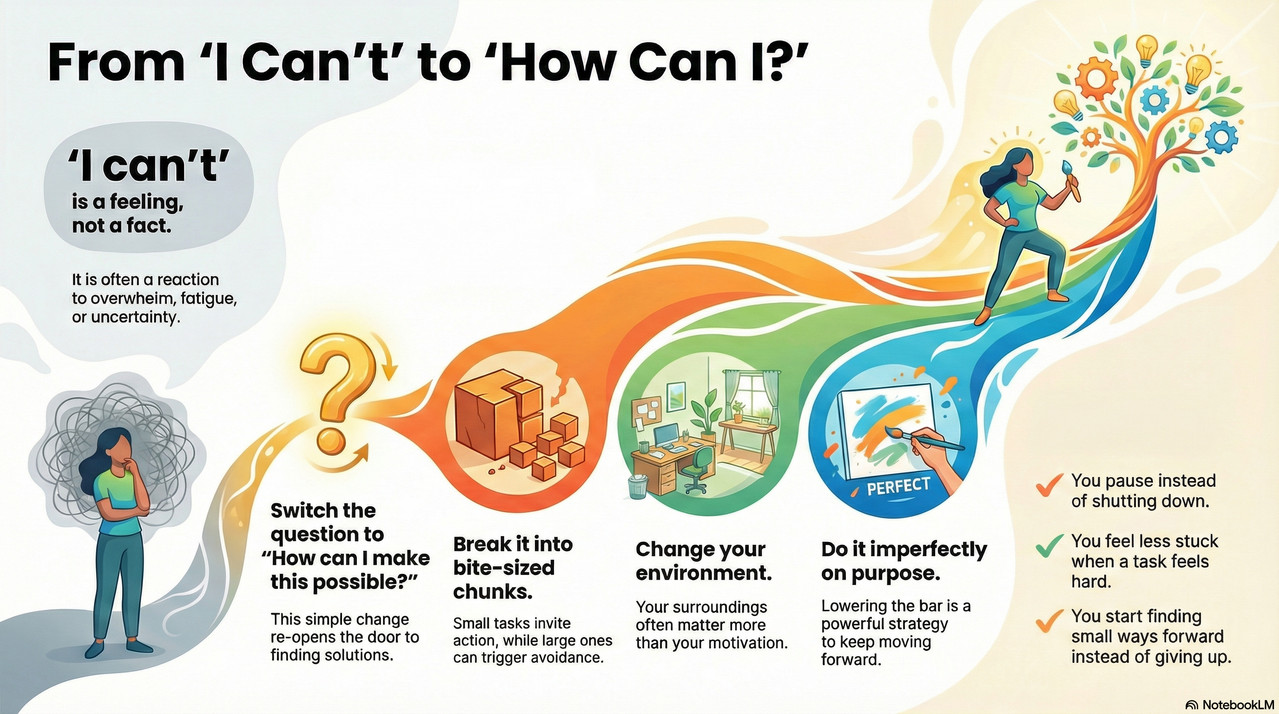
“I can’t” feels like a statement of fact, but most of the time it’s a reaction to overwhelm, fatigue or uncertainty.
Changing the question to “How can I?” reopens the door. It shifts you from self-criticism to problem-solving, which is a much calmer place to make decisions from.
This habit doesn’t magically make things easy. It makes them workable.
What to do
- For a few days, notice when you say or think “I can’t do that”. Write down the situation and what you were reacting to.
- Pick one example and rewrite it as a question: “How can I make this possible?”
- Use the ideas below to explore answers. You don’t need to use them all. One is enough.
Make it simpler or easier
If something feels too hard, it probably is.
Example: instead of “cook from scratch every night”, try “cook one simple meal and repeat it twice this week”.
Break it into bite sized chunks
Big tasks trigger avoidance. Small ones invite action.
Example: instead of “start exercising”, aim to put your trainers on and walk for five minutes.
Change the timing
Sometimes the task is fine, the timing is the problem.
Example: if evenings are chaos, try moving movement or meal prep to earlier in the day.
Change the environment
Your surroundings matter more than motivation.
Example: leave a water bottle on your desk, or keep workout clothes where you can see them.
Make fewer decisions
Decision fatigue makes everything feel harder. How can you plan ahead, automate or repeat choices.
Example: eat the same breakfast most days, or repeat the same two workouts each week.
Use/borrow/steal a plan from someone who has done it before
You don’t need to invent everything yourself.
Example: follow a simple beginner walking plan instead of designing your own routine.
Pair it with something you already do
Attach the new habit to an existing one.
Example: stretch while the kettle boils, or take a short walk after lunch.
Do it imperfectly on purpose
Lowering the bar keeps you moving.
Example: a messy meal is still a meal. A slow walk still counts as movement.
Get help, support or accountability from your support crew
You were never meant to do this alone.
Example: ask a friend to check in, join you for a walk, or simply not tempt you when you’re trying to stick to a plan.
- Choose one adjustment and try it. This is an experiment, not a commitment for life.
Common Mistakes to Avoid
- Treating this as just “positive thinking”
- Expecting one solution to fix everything
- Using “How can I?” to push harder instead of make things easier
- Forgetting that changing the task is allowed
What You’ll Need
- A notebook or notes app
- A pen
- A few real-life examples
- Willingness to experiment without judging yourself
How to Know It’s Working
- You pause instead of shutting down.
- You feel less stuck when something feels hard.
- You start finding small ways forward instead of giving up.
That shift is subtle, but powerful.
Your Next Check-In
Bring one “I can’t” moment and what you tried instead to our next session. We’ll look at what helped, what didn’t and how to make it even easier next time.